

A Documentary Analysis
25 September 2026
Questions This Paper Answers
What was the outcome of the Trump–Xi summit?
Did the United States and China sign a new trade deal?
What changed on Taiwan and AI?
What was the ceremony for?
What happens next in November and December?
I. The Short Version
The Washington summit extends the existing trade truce by two months, adds a limited set of goods-side understandings to be published on Monday, and locks in two further leader meetings before year-end. It does not produce a durable trade settlement, an AI compact, or a public change in U.S. policy on Taiwan.¹ ²
China sends two giant pandas to Atlanta and proposes a large student-exchange target. Both sides agree to keep talking about artificial intelligence. Those are the other announced deliverables.³ ⁴
The United States gains time and a Chinese commitment to appear at the Miami G20. China gains time, a high-honour state visit, and a U.S. commitment to appear at APEC in Shenzhen. The two-month extension is the device that keeps both incentives alive into November and December.⁵
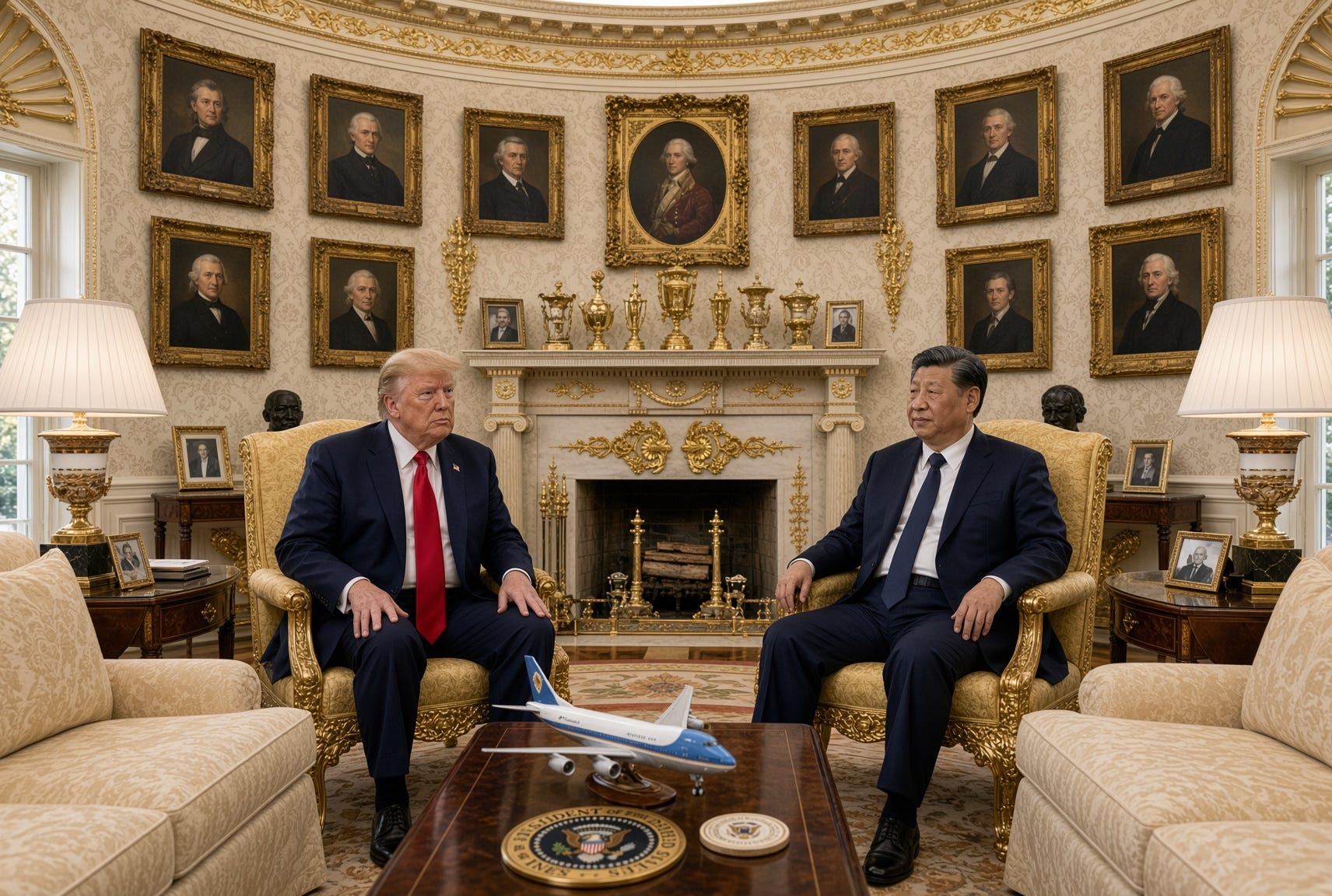
The visit was designed as ceremony with a thin commercial core. Flyovers, a tarmac greeting, a state dinner, tea with the two first ladies, and a National Archives tour carried more of the public event than the briefing papers did. That is a method, not an accident.⁶
The official record supports a narrow conclusion. The relationship is being managed as a sequence of meetings. It is not being closed as a bargain.
II. How to Read the Week
Xi Jinping completed a three-day state visit to Washington on 25 September 2026. It was his first formal visit to the capital in eleven years and the second Trump–Xi meeting of 2026, after Beijing in May.⁷
The public argument split immediately. One account treated warmth as a breakthrough. Another treated the absence of a grand bargain as failure. A third treated pandas, tariffs, Taiwan and AI as a single ledger.
They are not a single ledger.
Agreements establish what changed. Official readouts establish what each side wants the record to show. Colour from the visit establishes how the two leaders chose to perform the relationship. Where those layers conflict, the published terms prevail. Where the terms are incomplete, the paper says so.
They bought two months, two pandas, and two more meetings. That was the summit. The rest was granite, flyovers, and “we’ve never gotten along better.”
III. What the Record Says
The controlling public facts are few.
The trade truce negotiated after last year’s confrontation was due to expire on 10 November. The two sides extended it to 10 January 2027. China had sought a much longer horizon, including through the end of the current U.S. term. It received two months.⁸
U.S. Trade Representative Jamieson Greer said limited additional understandings cover agricultural exports, medical devices and some consumer and non-sensitive goods, with details due on Monday. Treasury Secretary Scott Bessent said China is meeting a 25-million-ton soybean commitment and lagging a separate farm-purchase pledge of about $17 billion.⁹ ¹⁰
China’s foreign ministry said the economic teams reached a “new joint arrangement.” It did not publish the schedule.¹¹
The two presidents agreed to support each other’s remaining 2026 summits: APEC in Shenzhen in November and the G20 in Miami in December.¹²
That is the operational core. Everything else is either dialogue, display, or an issue parked for the next meeting.
IV. Five Things That Moved
The summit produced five public results.
The first is time. The truce now runs to 10 January 2027. Time is the product. It keeps rare-earth, tariff and purchase talks inside a live deadline rather than a lapsed one.¹³
The second is a narrow goods understanding. The public record promises exemptions or carve-outs in specified categories. It does not yet publish volumes, tariff lines or enforcement terms. Monday’s release will determine whether this is a commercial instrument or a press line.¹⁴
The third is calendar lock-in. Trump attends APEC in China. Xi attends the G20 in Florida. Each leader gets the appearance he wanted from the other.¹⁵
The fourth is panda diplomacy. Two giant pandas go to the Atlanta Zoo.¹⁶
The fifth is process on AI. Both sides accept continued dialogue. Trump used the phrase “Super Intelligence.” Xi said the two countries should develop and manage AI “for good” and keep it under human control. No joint limit, inspection regime or model-access rule was announced.¹⁷
China also proposed bringing 100,000 American students to China. That remains a proposal on the public record, not a signed exchange program.¹⁸
V. Things That Didn’t Move
Taiwan stayed on the table and off the joint announcement.
China’s official readout says Xi told Trump the United States should “adhere to the correct position of opposing Taiwan independence” and handle the question “with prudence.” Washington issued no matching public reformulation. No halt to arms sales was announced. A pending U.S. weapons package remains an unclosed decision hanging over the November meeting.¹⁹ ²⁰
AI stayed in the category of conversation. The summit did not produce a shared definition of risk, a limit on model distillation, or a new export-control bargain.²¹
Iran, Ukraine and the Korean Peninsula appear in both readouts as subjects exchanged. They do not appear as settlements. Trump said the two sides had discussed Iran and that “we’re going to do great.” That is a political line. It is not an enforcement term.²²
Rare earths, technology restrictions and a multi-year purchase-and-tariff architecture remain inside the extended truce, not outside it. The January 10 date is the next hard stop.²³
The omissions are part of the result. A state visit can advertise stability without moving the files that would test it.
VI. Ceremony as Strategy
The visit ran on honour, access and spectacle.
Trump met Xi on the tarmac at Joint Base Andrews, breaking the usual White House arrival pattern. The program included a military flyover, an honor guard, a tour of a new South Lawn helipad, a black-tie state dinner with technology and finance chief executives, tea with Melania Trump and Peng Liyuan, and a closing tour of the Declaration of Independence, the Constitution and the Bill of Rights.²⁴ ²⁵
Trump’s public language was personal. He called the relationship a “truly great friendship,” said the two had “never gotten along better,” and told reporters Xi “loves good granite” after they inspected the helipad base. He presented a bald-eagle sculpture and offered the Chinese couple first entry to an unfinished White House ballroom. On Friday he compared national timelines at the Archives: “ours goes 250 years… theirs goes 6,000 years.” He said farmers would be “happy.”²⁶ ²⁷
Xi’s public language was institutional. He thanked the hosts for “meticulous care,” described “sincere and in-depth exchanges,” and defined the relationship as “strategic stability on the basis of respect, fairness and reciprocity.” He warned against a Thucydides trap and a “zero-sum gladiatorial contest,” and said competition should stay “within proper limits.” He recalled Chinese rescue of American pilots in the war against Japan.²⁸ ²⁹
The colour is evidence of method. Trump treats leader chemistry as an instrument. Xi treats ceremony as recognition of status and as a container for unfinished business. Both used the week to make the next two meetings politically easier to attend.
The warmth does not close Taiwan. It does not price rare earths. It does not write an AI rule. It does make a walk-away at Shenzhen or Miami more expensive for either man.
VII. What November and December Are For
The two-month extension is not a settlement. It is a bridge to two more leader encounters.
Xi wants Trump in Shenzhen. Trump wants Xi in Miami. The January 10 expiry sits after both events. Each side can still trade attendance, tone and incremental commercial text against the next deadline.³⁰
That structure explains the thinness of this week’s result. A larger deal delayed until November or December still has a venue, a host and a reason to keep the truce intact. A collapse before those meetings would strand both calendars.
The next test is therefore documentary, not theatrical. Monday’s trade text will show whether the “new joint arrangement” has lines and quantities. November will show whether Taiwan and technology stay in the talking points or enter the terms.
VIII. Saving Face, Options Open
The summit changed timing and choreography. It did not change the underlying files.
For two months the existing trade truce continues. China retains export access under that pause. The United States retains tariff leverage under the same pause. Both leaders retain a face-to-face path into year-end.³¹
The United States received a short extension rather than a long one, a promise of further farm and goods detail, and a Chinese date in Miami. China received honours, pandas as public diplomacy, a U.S. date in Shenzhen, and no public American restatement on Taiwan.³²
The personal record is real and limited. The two men performed friendship in the rooms designed for it. The documents they left behind are a calendar and a short commercial stay.
The implementation texts, not the dinner, will decide whether this week was a pause with a purpose or a pause in place of one.
Footnotes and Source Links
Reuters, “Trump, Xi end summit with tea, tour of US archives — and little sign of progress,” 25 September 2026.
https://www.reuters.com/world/china/trump-wrap-up-xi-summit-with-tour-us-archives-2026-09-25/Wall Street Journal / Mint, “Five Takeaways From Trump’s Washington Summit With Xi,” 25 September 2026.
https://www.wsj.com/world/china/five-takeaways-from-trumps-washington-summit-with-xi-88772c6dCNBC, “Trump, Xi wrap state visit spectacle over substance,” 25 September 2026.
https://www.cnbc.com/2026/09/25/trump-xi-summit-takeaways.htmlAssociated Press, “Takeaways from Trump-Xi summit: Lots of pomp and even more punting,” 25 September 2026.
https://apnews.com/article/trump-xi-visit-china-trade-ai-takeaways-f7b4922c12abca2bab7262019566c08cAtlantic Council, “What did (and didn’t) happen at the Trump-Xi summit,” 25 September 2026.
https://www.atlanticcouncil.org/content-series/fastthinking/what-did-and-didnt-happen-at-the-trump-xi-summit/The Guardian, “Pomp over progress as Trump rolls out red carpet for Xi,” 25 September 2026.
https://www.theguardian.com/us-news/2026/sep/25/donald-trump-xi-jinping-china-president-us-visit-red-carpet-treatmentCNBC, 25 September 2026; Reuters, 25 September 2026.
Reuters, “Five takeaways from Trump’s summit with Xi in Washington,” 24 September 2026.
https://www.reuters.com/world/china/four-takeaways-from-trumps-summit-with-xi-washington-2026-09-24/Reuters, 25 September 2026.
Wall Street Journal / Mint, 25 September 2026.
Ministry of Foreign Affairs of the People’s Republic of China, “President Xi Jinping Holds Talks with U.S. President Donald J. Trump,” 25 September 2026.
https://www.fmprc.gov.cn/mfa_eng/xw/zyxw/202609/t20260925_12031181.htmlIbid.
Atlantic Council, 25 September 2026.
Reuters, 25 September 2026.
Bloomberg Law, “Trump Says He’ll Meet Xi Twice More This Year as Summit Wraps,” 25 September 2026.
https://news.bloomberglaw.com/international-trade/trump-says-hell-meet-xi-twice-more-this-year-as-summit-wrapsCNBC, 25 September 2026.
Associated Press, 25 September 2026.
Hindustan Times, “Trump-Xi summit: What US and China agreed on,” 25 September 2026.
https://www.hindustantimes.com/world-news/trump-xi-jinping-summit-what-us-and-china-agreed-on-and-what-it-means-for-india-washington-white-house-state-dinner-101790309274879.htmlXinhua / MFA readout, 25 September 2026.
https://www.fmprc.gov.cn/mfa_eng/xw/zyxw/202609/t20260925_12031181.htmlAtlantic Council, 25 September 2026.
CNBC, 25 September 2026.
Reuters, 25 September 2026; RFI/AFP, “Trump, Xi end summit long on pomp, but short on progress,” 25 September 2026.
https://www.rfi.fr/en/international-news/20260925-trump-xi-inspect-founding-documents-of-us-democracy-to-close-summitWall Street Journal / Mint, 25 September 2026.
NBC News, “Trump rolls out red carpets for Xi Jinping,” 24 September 2026.
https://www.nbcnews.com/politics/donald-trump/trump-rolls-red-carpets-xi-jinping-though-portrayed-china-global-menac-rcna599250Reuters, 25 September 2026.
NBC News, 24 September 2026; BBC, “Trump and Xi exchange warm words at state dinner,” 25 September 2026.
https://www.bbc.com/news/articles/cxq63dqp93n1oRFI/AFP, 25 September 2026.
Xinhua, full text of Xi remarks at the state dinner, 25 September 2026.
https://english.news.cn/20260925/cd281bbcd4df4f848556276c9cdc3fff/c.htmlWall Street Journal / Mint, 25 September 2026.
Atlantic Council, 25 September 2026.
Reuters, 25 September 2026.
MFA readout, 25 September 2026; CNBC, 25 September 2026.